

The 15-Mile Problem: Why a Short Corporate Transfer from JFK Is Harder to Get Right Than a 200-Mile One
The trip everyone underestimates
A traveler lands at JFK at 2:40 p.m. with a 4:30 meeting in Midtown. On a map, the problem looks trivial: about fifteen miles, one borough crossing, a destination in the most transit-dense city in North America. Nobody plans a contingency for a fifteen-mile trip.
That is the trap.
On a 200-mile corridor, everyone builds slack into the plan. The traveler expects a long ride, the assistant books a buffer, and nobody is surprised when the clock matters. On the JFK-to-Manhattan run, the opposite happens. The distance is short enough that people treat the arrival time as a fact rather than a forecast. Then the Van Wyck slows, or the Belt Parkway backs up, or the flight lands twenty minutes early and the car is not there, or the car is there and the traveler is not, and a fifteen-mile trip becomes the most stressful leg of a two-thousand-mile itinerary.
Composite scenario, illustrative only: A three-person delegation lands within the same hour. One executive has checked bags, one has none, one is on a different terminal's arrival. Three rideshare requests go out. Two drivers accept, one cancels after the first pickup is already in motion, and the third arrives at the wrong curb. The meeting starts with two of three in the room.
This article makes a narrow argument. A short JFK-to-NYC transfer is not a shorter version of a long-haul transfer. It is a different problem, with different economics, and the right service is the one that solves that problem. We will also be plain about where that service is not the right answer, because on this corridor, the alternatives are genuinely good.
The two ideas this article uses
The Variance Premium. On a short trip, you are not buying distance or even average speed. You are buying a narrower range of possible arrival times. The average JFK-to-Midtown ride and the worst realistic JFK-to-Midtown ride can differ by more than the whole length of a good meeting. A service's value on this corridor is the degree to which it compresses that range.
The Curb-to-Car Interval. This is the Terminal Gap in reverse. On our long-haul corridors, the Terminal Gap describes the distance between a transport option's advertised endpoint and the actual gate. Here the traveler is already at the terminal, and the question becomes how long it takes to get from baggage claim to a moving vehicle. For many travelers, that interval, not the drive, is the largest source of avoidable lost time. We return to it in The Curb-to-Car Interval below.
Who actually books this, and why
A corporate transfer from JFK to NYC is usually booked by one of five kinds of client, and they want different things.
- The solo executive who values predictability and a quiet ride but could, with some tolerance for risk, take a cab or a train. For this traveler, the case for a private car is narrow and honest, and we make it in the Total Trip Cost Model below.
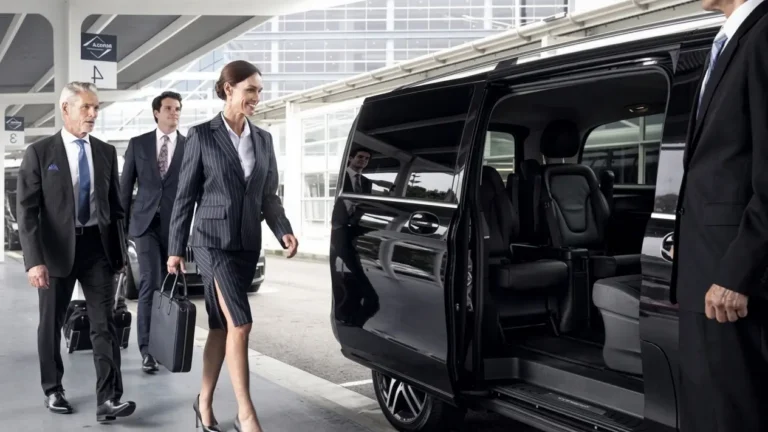
- The multi-executive team arriving on the same or overlapping flights. This is where private service has its strongest case (see Capacity and teams).
- The client or VIP arrival, where the person booking the car is not the person riding in it, and the host's reputation is part of the vehicle.
- The international delegation, often with heavy luggage, limited local familiarity, and a first impression to protect.
- The event or roadshow group, moving in and out of JFK across a compressed schedule with multiple vehicles and a coordinator who cannot afford surprises.
The honest concession: where the alternatives win
Every other corridor in this series has an alternative with a real weakness: no direct rail, no JFK-origin bus, a rideshare model with no binding commitment. JFK-to-NYC is different. The alternatives here are mature, fast, and in some cases cheaper. Pretending otherwise would cost this article its credibility with exactly the readers it is written for: travel managers who have already priced all of it.
Yellow taxis are competitive for solo travelers. The city's flat fare from JFK to Manhattan is predictable, regulated, and, once the surcharges and tip are added, not dramatically different from a private transfer in a good traffic hour.
AirTrain plus transit is the cheapest option and is sometimes the fastest. A traveler heading to Penn Station or a destination near a subway line can use AirTrain to Jamaica and LIRR, or AirTrain to the subway, and arrive on a timetable that traffic cannot touch. During a bad rush hour, this can beat any car.
The Rolling Office is weaker here. On our longer routes, the Rolling Office Stack argument is that a private car converts a three- or four-hour transfer into working time. On a 45- to 90-minute ride, there is less time to convert, and a traveler who needs to take a call has other places to take it.
The corridor is below the Threshold Distance. The Threshold Distance Calculation, introduced for longer corridors, asks at what distance a private car's total benefits outweigh a self-directed alternative. For JFK-to-NYC, the calculation does not clearly favor private service on distance alone. It favors private service only when something other than distance is doing the work: group size, luggage, flight uncertainty, the stakes of the arrival, or the cost of failure.
That last sentence is the thesis of this article, and the rest of it is an attempt to define what "something other than distance" means in operational terms.
The Total Trip Cost Model, short-haul edition
The Total Trip Cost Model, used across this series, says that the fare is only one component of what a trip costs. On a long-haul route, the other components are mostly time and productivity. On the JFK-to-NYC corridor, they are mostly risk and coordination.
| Cost component | Yellow taxi | AirTrain + transit | Rideshare | Private car service |
|---|---|---|---|---|
| Fare | Flat fare to Manhattan, plus surcharges, tolls and tip | Lowest | Varies, with surge pricing at peak hours | Highest, quoted in advance |
| Drive time variance | Exposed to traffic | Runs on a timetable that traffic cannot touch | Exposed to traffic | Exposed to traffic, watched by dispatch |
| Curb-to-Car Interval | Taxi line, longer at peak hours | Walk to AirTrain, then train frequency | Starts after landing: request, match, driver travel | Car staged before the traveler clears the terminal |
| Coordination | One cab per small group, no shared plan | Every traveler on their own | One request and one driver per traveler | One booking, one point of contact |
| Luggage | Limited trunk space | Carried by hand through stations | Depends on the vehicle that accepts | Vehicle chosen for the bag count |
Two things stand out.
First, for a solo traveler with light luggage and a destination on a transit line, a private car is rarely the cheapest option and is not guaranteed to be the fastest. Its case rests on the Variance Premium and the traveler's tolerance for variance.
Second, for a group with luggage and a fixed meeting time, the costs in the last two rows (coordination and luggage) begin to dominate, and the table tips. We turn to that now, after taking up the part of the trip that rideshare and cab comparisons usually skip.
The Curb-to-Car Interval
Most transit comparisons measure from the moment the wheels start moving. The traveler, however, starts the clock when the plane touches down. Between those two moments sit deplaning, immigration and customs if the flight is international, baggage claim, and the walk to pickup. Then, after all of that, the traveler waits for a car that may not yet be at the terminal.
This is the Curb-to-Car Interval, and it is the stretch where a dispatched private service is structurally different from an on-demand one.
An on-demand model starts when the traveler asks. The request is typically made after landing, and the driver is matched, then travels to the pickup point, then navigates the airport's for-hire pickup rules. All of that is after the traveler is ready to go.
A dispatched model can start before the traveler lands. If dispatch tracks the flight, the vehicle can be positioned and the driver ready by the time the traveler clears the terminal.
Airport pickup logistics also change. JFK's for-hire vehicle pickup arrangements have been in flux with terminal construction and relocations; our earlier research found that Terminal 4's for-hire pickup moved to Zone B effective December 30, 2025. A traveler who has never used the airport's pickup scheme can lose a surprising amount of time walking to the wrong zone.
The Curb-to-Car Interval is where the Variance Premium is most easily seen. The drive itself has an irreducible range of outcomes. The wait for the car does not need to.
Capacity and teams: the strongest case for private service
If there is one situation in which a private car service clearly wins on this corridor, it is the group arrival.
Consider the arithmetic. Three executives land together. A single yellow cab seats three or four passengers but struggles with their luggage. A rideshare request can be made for an SUV, but it matches to whichever driver accepts. Three separate requests produce three separate drivers, three arrival times, three pickup points, and three chances for something to go wrong.
This is where the Acceptance Gap, developed in the JFK-to-Boston piece, comes back. A rideshare platform's matching model has no binding commitment: a driver can decline or cancel with no consequence on the driver's side. On a long interstate trip, that risk is dramatic. On a short corporate group transfer, it is less dramatic but still real, because the cost of a cancellation lands on a group whose members are all on the clock.
Capacity is the second issue. Capacity Certainty and the Three-Call Capacity Model exist because "we have an SUV" is a different claim from "we have a vehicle that holds six people and eight bags." From our earlier research, the 2024 Cadillac Escalade ESV offers roughly 41.5 cubic feet of cargo behind the third row and 94.1 behind the second, while the Lincoln Navigator L offers roughly 34.3 and 73.3 respectively. The standard-length versions of both carry far less. For a group with full-size luggage, those differences determine whether passengers or bags ride in the vehicle.
For families on corporate relocation or executives traveling with children, New York's child-restraint law (under 8 years old, rear-facing under 2) adds a layer that most corporate-travel guides skip.
Accountability when the flight slips
Short trips depend on a long chain of things that go right. A flight is early. A flight is late. A flight is rerouted to a different terminal. The traveler cannot be reached. The meeting moves. At each point, someone has to own the problem.
This is the Three Layers of Accountability, applied to a short corridor:
- The vehicle layer. Is the car where it is supposed to be, clean, and in working order?
- The driver layer. Is the driver the person the client was told to expect, and do they know what to do if the traveler is not at the pickup point?
- The dispatch layer. Is someone watching the flight, the traffic, and the clock, and empowered to change the plan before the traveler has to ask?
A taxi or rideshare driver can only be accountable at the first two layers, and only for the trip they have accepted. The third layer, the one that watches the whole trip, exists only if the service has one.
"NYC" is not one place
A quote for "JFK to NYC" is not a quote for a trip. The destination is one of at least five different problems.
- Midtown. The densest traffic, the most restricted curbside, and the most variable final approach. Building drop-off and loading-zone rules matter more than the highway segment before them.
- Financial District / Lower Manhattan. Different approach roads, different tunnel and bridge options, and different congestion behavior.
- Hudson Yards / West Side. A newer corporate cluster, with approach logistics that differ again.
- Brooklyn and Long Island City. Often the shortest trips from JFK, but not necessarily the simplest, and the ones where the choice of route matters most.
- Outer-edge destinations (Westchester, northern New Jersey). Not in-city trips at all. They behave more like the longer corridors in this series, and the right comparison is different.
This connects to the Door-to-Door Decision Matrix: the relevant question is not "JFK to what?" but "JFK to which door, at what time, with whom?" A car that can name the building, the loading zone, and the likely hold time at the destination makes the last two hundred feet of the trip as predictable as the first two hundred.
Security, discretion, and chain of custody
For corporate travelers, the ride is often more than a ride. It is a closed space in which confidential calls happen, documents are handled, and sensitive clients are moved. This is where service differences that never show up on a price comparison begin to matter.
To avoid overclaiming, a boundary: this section is about discretion and professionalism, not executive protection. Where a traveler's profile warrants armored transport or a formal protective detail, that is a separate service, addressed in our Protection Gap piece, and the two should not be confused. A standard corporate transfer is not an armored transport, and this article does not imply otherwise.
A reader who cares about this section is a reader who is already asking whether a service has real standards. The most credible answer is a specific one, so these are the questions worth putting to any provider, us included:
- Who is the chauffeur, and is it the same person named in the confirmation?
- Is the vehicle dedicated to this booking for the whole trip, or shared with other jobs?
- Who at the company can see the passenger's name, flight, and destination?
- What happens to anything left behind in the vehicle?
What the Variance Premium means in practice
Pulling the threads together: on a 15-mile corridor, the case for a private corporate car does not rest on speed or price. It rests on four things.
- A narrower range of arrival times, because dispatch monitors the flight and the road, not only the trip that has already begun.
- A shorter Curb-to-Car Interval, because the vehicle and driver are ready when the traveler is.
- Group coordination, because one booking and one point of contact replace several separate requests.
- Accountability at every layer, because a person, not an algorithm, owns the outcome.
If none of those four is relevant to a particular trip, the honest recommendation may be a cab or the train. For a solo traveler with a light bag and a destination near Penn Station, we would not argue otherwise.
But if the traveler is carrying the weight of a meeting, a client, or a group, then the fifteen miles are doing something they do not appear to be doing. They are the last link in a chain, and the chain is only as strong as that link.
Book Your Chauffeur
Ready to ride in effortless luxury?
Secure your chauffeured journey in moments. Our concierge team is available around the clock.
Related Topics
 Corporate Travel
 Solutions: Direct Airport Car Service from JFK to Baltimore Business Parks
For corporate travel planners and executive assistants, coordinating intercity transit along the Northeast Corridor can be a logistical headache. When…
Read Article