
Beyond “Jersey”: Why a Private Car from JFK to New Jersey Is Five Different Trips
The quote problem
Ask three providers for a price from JFK to "New Jersey" and you will get three numbers that cannot be compared. They are not answering the same question, because "New Jersey" is not a destination. It is a state, and a state is the wrong unit for a ride.
A traveler heading to a Hoboken apartment, a traveler connecting to a flight at Newark Liberty, and a traveler headed to a Princeton faculty meeting are taking three different trips. They cross different bridges, face different alternatives, and pay different hidden costs. Most JFK-to-NJ content online ignores this and offers a generic list of "reasons to book a car." This piece does the opposite. It breaks the corridor into its real parts, says where a private car wins, and says plainly where it does not.
Two new frameworks organize the piece: The Five Jerseys and The Crossing Asymmetry. Both lean on frameworks already established in this series, which are referenced rather than re-derived.
The Five Jerseys
The Five Jerseys is the claim that a JFK-to-NJ quote only means something once the destination is placed in one of five sub-regions. The boundaries blur at the edges (Morris, Somerset and Hunterdon counties don't fit neatly), so the framework makes a narrow claim: a provider who quotes "New Jersey" without asking which Jersey has not understood the trip.
1. The Hudson Waterfront. Jersey City, Hoboken, Weehawken and the river towns facing Manhattan. This traveler is geographically closest to the city, so the real competitor to a private car is the rail chain through Penn Station and PATH or NJ Transit. What decides the trip: luggage volume, time of day, and how much the traveler values a single handoff-free ride.
2. Newark and the Airport Belt. Newark, Elizabeth, and Newark Liberty International (EWR). Many travelers here are moving between airports, which turns a ground transfer into a flight-connection problem. What decides the trip: how much schedule margin the traveler actually has.
3. Bergen and the Meadowlands. Hackensack, Teaneck, Paramus, and the stadium complex. This region is reached through different river crossings than the waterfront, and event days change the traffic picture. What decides the trip: crossing choice and event-day timing.
4. Central Jersey. New Brunswick, Edison, Princeton and the Route 1 corridor. This is a real long-haul trip. One route-planning aggregator puts the road distance from JFK to Princeton at roughly 60 miles and about 1 hour 25 minutes, against roughly 2 hours 20 to 2 hours 30 minutes by rail with transfers, at $16 to $50. What decides the trip: total time and the number of handoffs, because there is no direct train from JFK to Princeton.
5. The Shore and the South. Monmouth and Ocean counties and, at the far end, Atlantic City. What decides the trip: seasonal Garden State Parkway demand. The Atlantic City-to-JFK guide in this series covers the shore-surge pattern and the Day-Tripper Infrastructure Gap in detail, so this piece only flags the connection.
The practical output of the framework is one question every booking should answer first: which Jersey, and in which direction?
What the train can and cannot do: the Terminal Gap
The Terminal Gap, introduced in the Baltimore corridor piece, is the difference between a transportation option's advertised endpoint and JFK's actual gate. It applies here in its purest form.
There is no direct rail link between JFK and New Jersey. A transit-map source describing the AirTrain system lays out the chain: AirTrain to Jamaica, LIRR to Penn Station, then NJ Transit or PATH onward. For Newark Airport the same source describes three transfers and advises a generous margin. Every leg works on its own terms. The Terminal Gap is the sum of the handoffs.
To be fair to the rail chain, each leg is frequent, and it is often cheap. The AirTrain fare has been cited at roughly $8.50 to $8.75 depending on source and date, and LIRR CityTicket fares between Jamaica and Penn have been cited at $5.25 off-peak and $7.25 at peak. For a traveler with one bag and a Penn Station-adjacent destination, that chain can be the right answer.
The chain stops working when the destination is not next to a Penn Station connection, when luggage multiplies, when the traveler is carrying a child, or when the trip happens at 5 a.m. or midnight. Add the Fixed-Endpoint Problem, the observation that rail speed is measured station to station and not curb to curb, and the apparent advantage shrinks on both ends of the journey.
Framework 2: The Crossing Asymmetry
The second framework is about money, and it is the one most likely to surprise a traveler.
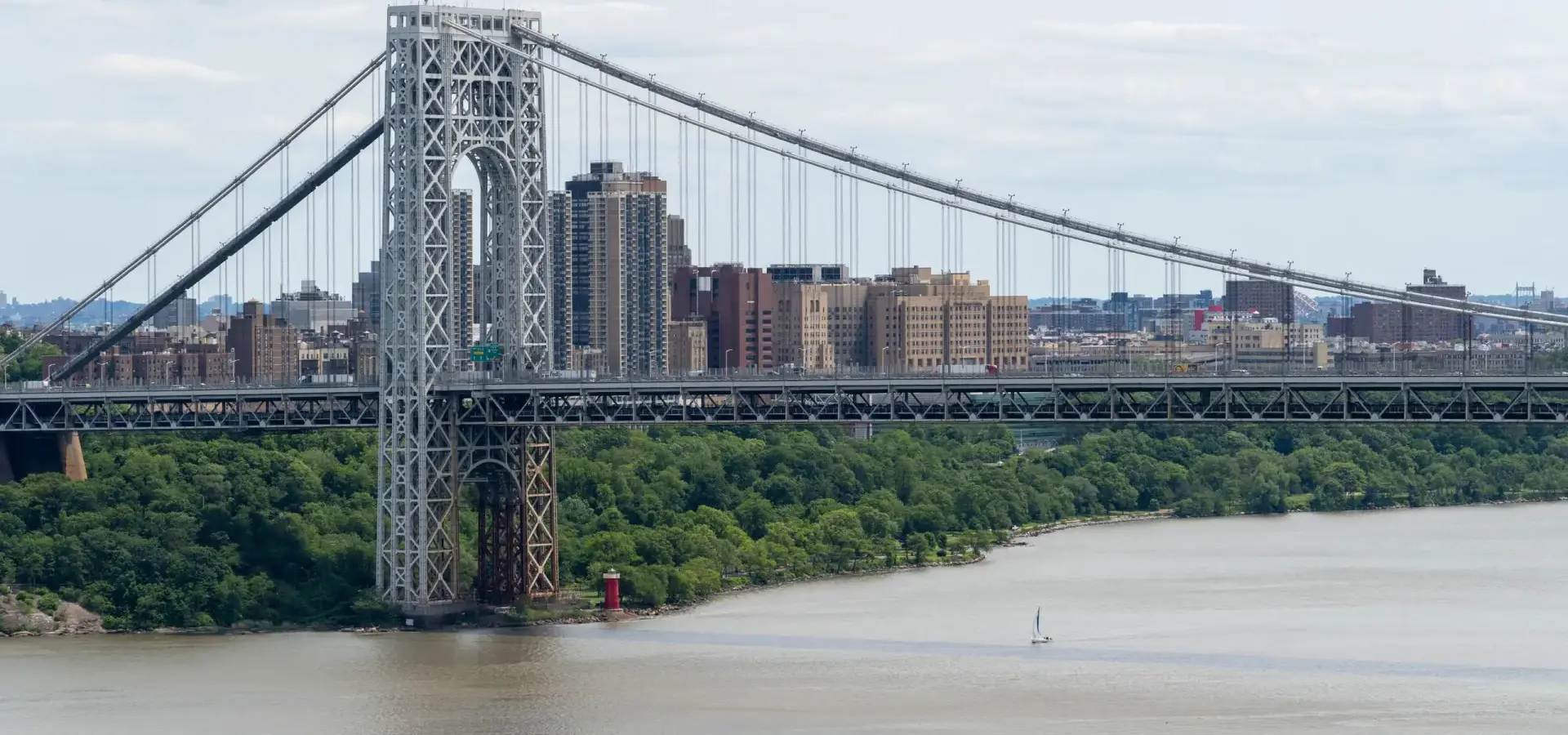
The Crossing Asymmetry is the fact that Hudson and Arthur Kill crossings are priced by direction. The Port Authority collects tolls on its bridges and tunnels, including the Holland and Lincoln tunnels, the George Washington, Bayonne and Goethals bridges, and the Outerbridge Crossing, in the eastbound direction only, meaning into New York. As of January 2026, a 3 percent increase took the E-ZPass peak rate for cars to $16.79 and the off-peak rate to $14.79, while pay-by-plate tolls by mail exceed $23.
The consequence for JFK-to-NJ is direct. On a JFK-to-New Jersey trip the Port Authority crossing itself is westbound and not tolled. The return trip, NJ to JFK, enters New York and pays. The same car, same distance, same hour, and two different cost profiles depending on direction. Depending on route, other tolls may apply on the New York side of a trip, for example Verrazzano-Narrows Bridge tolling, which MTA changed in January 2026.
This matters for three reasons.
- Round-trip quotes can hide the asymmetry. A provider can fold the return toll into a flat price, charge it as a pass-through, or leave it vague. Travelers should ask which.
- Peak versus off-peak is a real variable. The $2 difference between E-ZPass peak and off-peak is small, but the gap to the pay-by-plate rate is large. A fleet with E-ZPass avoids the premium. A traveler paying by plate in a rental car does not.
- Quotes should state direction and route. "JFK to Jersey City via the Holland Tunnel" and "Jersey City to JFK via the Holland Tunnel" are not the same line item.
Total Trip Cost: three representative trips
The Total Trip Cost Model holds that a price is only comparable once time, last-mile legs, luggage handling and risk are included. Below are three representative trips. Only verified public components are filled in.
| Destination | Public-transit chain | What is verified publicly | Private car |
|---|---|---|---|
| Hoboken / Jersey City | AirTrain, LIRR to Penn, then PATH or NJ Transit | AirTrain and LIRR fare ranges above; no direct JFK-NJ rail | $135 flat rate (+ tolls) · ~50 min drive time |
| Newark Liberty (EWR) | AirTrain, LIRR, NJ Transit, EWR AirTrain | Three transfers per a transit-map source; EWR AirTrain fee is bundled into the NJ Transit ticket for the airport station | $165 flat transfer rate · ~75 min drive · 38.5 road miles |
| Princeton | Rail via Penn, with transfers | About 2h20-2h30 and $16-$50 per an aggregator; about 60 road miles and 1h25m by car | $240 long-distance corridor rate · ~1h25m drive time |
The honest takeaway from this table is not "the car always wins." It is that the rail chain's cost is only the visible part of its price. The invisible parts are time, handoffs, and what happens to a heavy bag at each of them.
Where a private car loses
A content series built on evidence has to say this out loud.
For the solo traveler with one bag heading to the Hudson Waterfront, the rail chain or a rideshare can be better. It is cheaper, it runs often, and the traveler loses little by transferring. This series' Acceptance Gap, the idea that a rideshare match carries no binding commitment for the driver, is most powerful on long interstate trips. On a short hop to Jersey City it matters less, and this piece does not claim otherwise.
Traffic is not a private-car advantage in itself. A chauffeured car in gridlock is a very comfortable way to be late. The Congestion Tax, the time lost at named chokepoints, applies to every vehicle on the road. The Van Wyck Expressway segment identified in an earlier piece sits at the front of any JFK departure by car, and the river crossings sit at the back. What a professional operation adds is not immunity from traffic. It is planning for it.
A private car is not the right tool for every Jersey trip. If the traveler is going to a Penn Station-adjacent address in Manhattan and then onward, the corridor in question is not JFK to NJ at all.
The airport-to-airport trip
The Newark Airport Belt deserves its own treatment because the traveler's stakes differ. Someone moving from JFK to EWR is usually not sightseeing. They are connecting.
Published estimates of JFK-to-EWR distance and time vary widely between sources, which is itself informative: a trip with this much variance deserves a buffer rather than a promise.
Three things matter more here than on any other corridor in this piece.
- Ticketing structure. Whether the two flights are on one ticket or separate tickets determines who bears the risk of a missed connection. That is an airline question, and the traveler should verify it with the carrier before choosing a transfer plan.
- Baggage. Whether bags are checked through changes how many handoffs the traveler has to manage on the ground.
- Capacity Certainty. The Three-Call Capacity Model, which asks whether a provider can confirm vehicle, driver and backup before the trip rather than after, is most relevant when a missed pickup would cost a flight.
The rail chain's three transfers, in particular the Penn Station leg, are where self-managed risk concentrates. A single vehicle, a single handoff, and a single point of accountability reduce the places where the trip can break. That is an argument about concentration of risk, and it does not guarantee an on-time arrival.
Families crossing a state line
A JFK-to-NJ trip crosses a state line, so two child-restraint laws are in play, and they are not identical.
New Jersey's statute, as published by the legislature, sets tiers that combine age and weight or height. A child under two years and under 30 pounds must be in a rear-facing seat with a five-point harness. A child under four and under 40 pounds must be in a rear-facing or forward-facing five-point-harness seat. A child under eight and under 57 inches must be in a forward-facing harness seat until outgrowing it, then in a booster. The statute places children in the rear seat where one is available. New York's law, referenced in earlier pieces in this series, is similar in spirit but not identical in structure.
The Seat Certification Chain, the idea that what matters is the provenance and continuity of how a seat was selected, installed and inspected, applies here. The honest framing from the Baltimore family piece carries over: professional installation is not claimed to be safer than a competent parent's own correct installation. What a provider can offer is a documented standard and a known starting point.
The Continuous Supervision Principle, the argument for keeping a child in one supervised vehicle rather than moving them through a multi-leg transit chain, is the strongest family-specific argument for a private car on a corridor with no direct rail. A rail chain through Jamaica and Penn means several platforms, several stairways, and several occasions for a child to be out of arm's reach.
Executives and the Hudson Waterfront
For the Jersey City and Newark business corridors, the series' earlier executive frameworks apply with a corridor-specific twist.
The Boardroom Continuity Index, how much of a traveler's working time survives the journey, and the Rolling Office Stack, the set of in-vehicle conditions that make work possible, both argue for a single vehicle over a multi-leg chain, because each platform change breaks a call or a document. A rail chain is not impossible to work through. It is simply interrupted more often.
The corridor-specific point is that the Hudson Waterfront and Newark have strong rail competition into Manhattan, but that is a different corridor. For travelers whose origin is JFK and whose destination is a New Jersey office address, the competing option is not a direct train. It is the same AirTrain-LIRR-Penn-PATH chain described above, with a last-mile leg at the end.
Pickup logistics at JFK
The curb matters because it is where the trip begins. JFK Terminal 4's for-hire-vehicle pickup was relocated to Zone B effective December 30, 2025. A provider should state, in the confirmation message, the specific pickup point and how the driver will be identified, and what happens if the flight lands early or late.
On that last point, every FA Luxury Transport airport transfer includes complimentary flight tracking, so your chauffeur adjusts to an early or late landing automatically. Tell us which Jersey you are heading to, and in which direction, and request a free quote. Traveling with children? Our family car service includes baby car seats, and corporate travel is built for trips like the Jersey City and Newark business runs.
Book Your Chauffeur
Ready to ride in effortless luxury?
Secure your chauffeured journey in moments. Our concierge team is available around the clock.
Related Topics
 Airport Transfers
The 15-Mile Problem: Why a Short Corporate Transfer from JFK Is Harder to Get Right Than a 200-Mile One
A traveler lands at JFK at 2:40 p.m. with a 4:30 meeting in Midtown. On a map, the problem looks…
Read Article Corporate Travel
 Solutions: Direct Airport Car Service from JFK to Baltimore Business Parks
For corporate travel planners and executive assistants, coordinating intercity transit along the Northeast Corridor can be a logistical headache. When…
Read Article